
The BYD Atto 2 is a compact electric SUV designed for buyers who want the practicality of an SUV without moving into the larger and more expensive BYD Atto 3. Positioned between the BYD Dolphin and Atto 3, it offers five seats, a technology-focused interior, strong safety equipment and the low running costs associated with an electric vehicle.
In Nepal, the Atto 2 is particularly suited to Kathmandu Valley commuters, small families and buyers upgrading from a hatchback or small petrol SUV. Its compact dimensions make it easier to manage in urban traffic, while its electric motor provides immediate torque for everyday driving. The car is also equipped with BYD’s Blade Battery and e-Platform 3.0, with Cell-to-Body construction adding to its structural design.
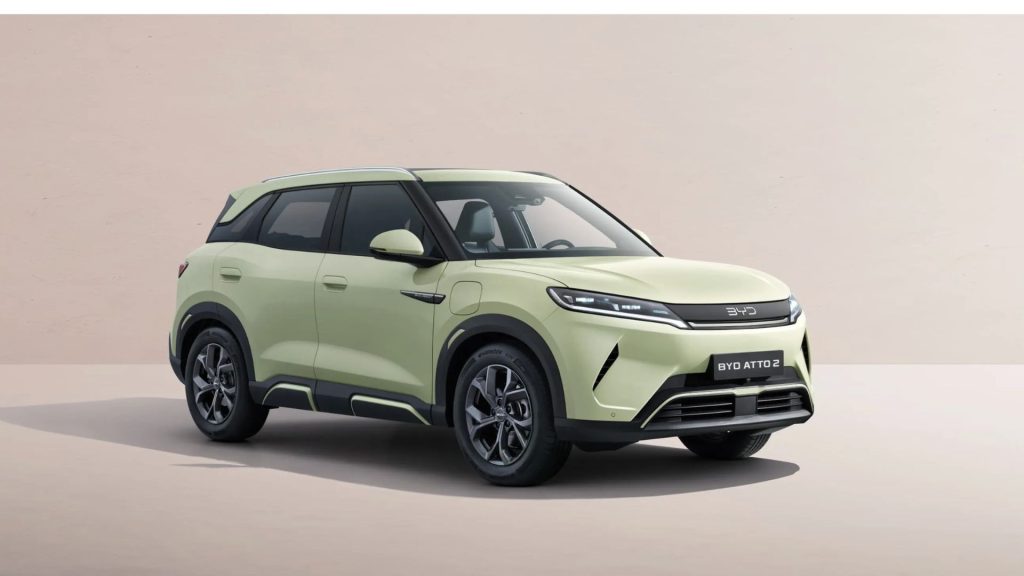
However, the BYD Atto 2 is not designed as an off-road SUV. Nepal’s hilly terrain, rough road sections and limited charging infrastructure outside major routes are important factors to consider before buying one. Its front-wheel-drive layout is suitable for paved and moderately rough hill roads, but buyers who regularly travel on muddy, damaged or remote roads may need to consider alternatives.
This BYD Atto 2 review in Nepal looks beyond its specification sheet to examine its price, range, charging, performance, comfort, safety and ownership experience. Most importantly, we’ll look at how well the Atto 2 fits the roads, climate and everyday driving conditions that Nepali EV buyers actually face.
BYD Atto 2 Price in Nepal
The BYD Atto 2 price in Nepal starts at NPR 45.99 lakh for the Essential variant. The Premium variant costs NPR 48.99 lakh, making the two variants relatively close in price while offering different battery capacities and claimed driving ranges.
| Variant | Battery | Claimed Range | Price in Nepal |
|---|---|---|---|
| Atto 2 Essential | 45.12 kWh | 312 km | NPR 45.99 lakh |
| Atto 2 Premium | 51.13 kWh | 345 km | NPR 48.99 lakh |
The Essential uses a 45.12 kWh Blade Battery, while the Premium gets a larger 51.13 kWh battery. This gives the Premium a 33 km advantage in its claimed range. Both versions use the same 100 kW motor and 290 Nm of torque, so the main difference between them is the battery capacity and associated equipment.
At NPR 45.99 lakh, the Essential makes the Atto 2 an interesting option for buyers looking for a compact electric SUV below the 50-lakh mark. Meanwhile, the Premium’s larger battery makes more sense for buyers who regularly travel beyond Kathmandu and want additional range between charging stops.
However, EV prices in Nepal can change because of tax, customs and importer-level revisions. The listed prices should therefore be confirmed with Cimex, the authorised BYD distributor in Nepal, before making a purchase decision.
Our take: For mostly urban driving with reliable home charging, the Atto 2 Essential offers the stronger value proposition. If you frequently travel on Nepal’s highways and hilly routes, the Premium is worth considering for its larger battery and higher claimed range.
BYD Atto 2 Specifications at a Glance
The BYD Atto 2 is a five-seat compact electric SUV with front-wheel drive and a permanent-magnet synchronous motor. Both Nepal-market variants use BYD’s e-Platform 3.0 and LFP Blade Battery technology, while the key difference is battery capacity and claimed range.
BYD Atto 2 Specifications
| Specification | Atto 2 Essential | Atto 2 Premium |
|---|---|---|
| Vehicle type | Compact electric SUV | Compact electric SUV |
| Seating capacity | 5 | 5 |
| Drive type | Front-wheel drive | Front-wheel drive |
| Motor | Permanent-magnet synchronous | Permanent-magnet synchronous |
| Maximum power | 100 kW / ~136 PS | 100 kW / ~136 PS |
| Maximum torque | 290 Nm | 290 Nm |
| Battery capacity | 45.12 kWh | 51.13 kWh |
| Battery chemistry | LFP Blade Battery | LFP Blade Battery |
| Platform | BYD e-Platform 3.0 | BYD e-Platform 3.0 |
| Construction | Cell-to-Body (CTB) | Cell-to-Body (CTB) |
| Length | 4,310 mm | 4,310 mm |
| Width | 1,830 mm | 1,830 mm |
| Height | 1,675 mm | 1,675 mm |
| Wheelbase | 2,620 mm | 2,620 mm |
| Ground clearance | Approximately 200 mm* | Approximately 200 mm* |
| Claimed range | 312 km | 345 km |
| Top speed | Approximately 160 km/h | Approximately 160 km/h |
*Ground-clearance figures require some caution. Local reports quote approximately 200 mm, while international technical data can show lower laden-clearance figures. For Nepal, the clearance with passengers and luggage is more relevant than the unladen showroom figure.
On paper, both variants share the same 100 kW motor and 290 Nm of torque, so there is no major difference in motor output between the Essential and Premium. The Premium’s advantage comes primarily from its larger 51.13 kWh battery and higher claimed range.
The 4,310 mm length and 2,620 mm wheelbase also give the Atto 2 a useful balance for Nepal. It is large enough to work as a family SUV while remaining more manageable in Kathmandu’s crowded roads and parking spaces than a larger electric SUV.
However, buyers should be careful when comparing these specifications with international Atto 2 reviews. Some overseas versions use different battery capacities and a 130 kW motor, meaning their performance figures cannot automatically be applied to the Nepal-market model.
Range and Charging
The BYD Atto 2 offers two battery options in Nepal. The Essential gets a 45.12 kWh battery with a claimed 312 km range, while the Premium uses a 51.13 kWh battery with a claimed 345 km range.
However, Nepal’s hills, traffic, temperature, passengers and air-conditioning can reduce real-world range. A practical estimate is:
| Driving Condition | Essential | Premium |
|---|---|---|
| Kathmandu city | 230–270 km | 250–295 km |
| Mixed city/highway | 205–245 km | 225–275 km |
| Hilly roads | 175–220 km | 195–245 km |
| Heavy load + AC + steep climbs | 160–205 km | 180–225 km |
For a typical Kathmandu driver covering 30–40 km per day, either variant should be sufficient for regular commuting. However, longer trips such as Kathmandu–Pokhara should be planned with a charging stop or adequate battery reserve.
Charging
The Atto 2 supports Type 2 AC charging and DC fast charging. A 7 kW AC charger can take around 7–9 hours for a full charge, while DC charging from 10–80% can take roughly 35–40 minutes under suitable conditions.
Home charging is likely to be the most convenient option for Kathmandu owners. At an illustrative electricity rate of NPR 10–12 per kWh, charging costs are estimated at around NPR 500–600 for the Essential and NPR 560–680 for the Premium, including charging losses.
Verdict on range: The Atto 2 is well suited to daily urban use, but buyers should not expect the full claimed range on Nepal’s hilly highways. The Premium’s larger battery makes it the better choice for frequent intercity travel.
Performance and Driving Experience
The BYD Atto 2 uses a 100 kW electric motor producing 290 Nm of torque in both Nepal-market variants. This gives it quick low-speed response, which is useful in Kathmandu traffic and during overtaking.
The Nepal-market version is reported to accelerate from 0–100 km/h in around 9 seconds. It uses a single-speed transmission and offers a smooth power delivery without the gear changes found in conventional petrol SUVs.
Depending on the local specification, driving modes such as Eco and Sport are available. Eco is better suited to daily Kathmandu driving, while Sport can provide a sharper response when overtaking.
On highways, the Atto 2 has enough performance for normal Nepal driving. However, high speeds, steep climbs, passengers and air-conditioning can increase energy consumption significantly.
Overall: The Atto 2 is not built as a performance SUV. Its strength is its smooth power delivery and instant torque, giving it enough performance for city driving, highways and regular paved hill routes.
Driving the BYD Atto 2 in Kathmandu
The BYD Atto 2’s 4.31-metre length makes it reasonably easy to manage in Kathmandu’s busy streets. Its elevated seating position, light controls and instant electric torque are useful in stop-and-go traffic.
Parking should also be relatively straightforward, thanks to the reversing camera and parking sensors. Better-equipped versions can offer a 360-degree camera, which is particularly useful in Kathmandu’s tight parking spaces and narrow roads.
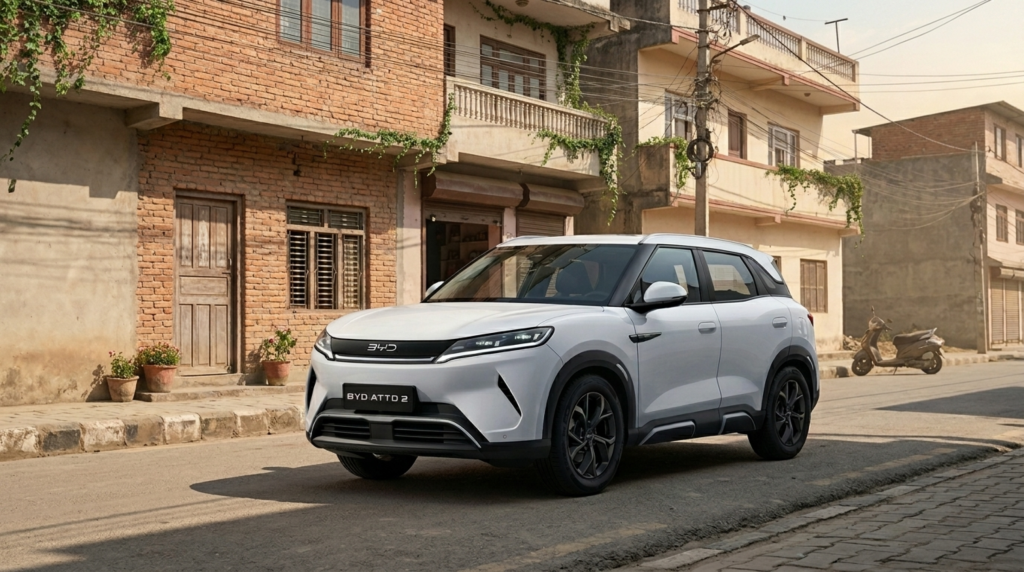
However, the Atto 2 is 1.83 metres wide, so it is not especially narrow. Drivers may need extra care in older neighbourhoods, crowded market areas and narrow basement ramps.
In traffic, regenerative braking can help recover some energy while reducing the need for conventional braking. However, frequent air-conditioning use, short trips and heavy congestion can still affect efficiency.
For Kathmandu: The Atto 2’s compact SUV dimensions, smooth electric drive and easy low-speed response make it a good fit for daily urban driving, provided its width is manageable for your usual routes and parking spaces.
How Does the BYD Atto 2 Perform on Nepal’s Hilly Roads?
The BYD Atto 2’s 290 Nm of instant torque is useful on Nepal’s uphill roads, allowing it to build speed smoothly without waiting for gear changes. It should handle regular paved climbs around the Kathmandu Valley and major hill routes comfortably under normal loads.
Its front-wheel-drive layout is suitable for paved and moderately challenging roads, but it is not intended for serious off-road use. Loose gravel, mud and slippery surfaces can reduce traction, particularly on steep climbs.
The Atto 2 also benefits from hill-hold assistance and regenerative braking. Regeneration can help control speed while descending and recover some energy, although drivers should still use the conventional brakes when necessary.
Ground clearance is another positive for Nepal, especially when dealing with speed breakers and uneven sections. However, carrying five passengers and luggage on steep climbs will increase energy consumption.
For Nepal’s hills: The Atto 2 is well suited to paved hill roads and regular intercity routes, but buyers who frequently travel on rough, muddy or remote mountain roads should consider a vehicle with stronger traction and more off-road capability.
Interior, Comfort and Practicality
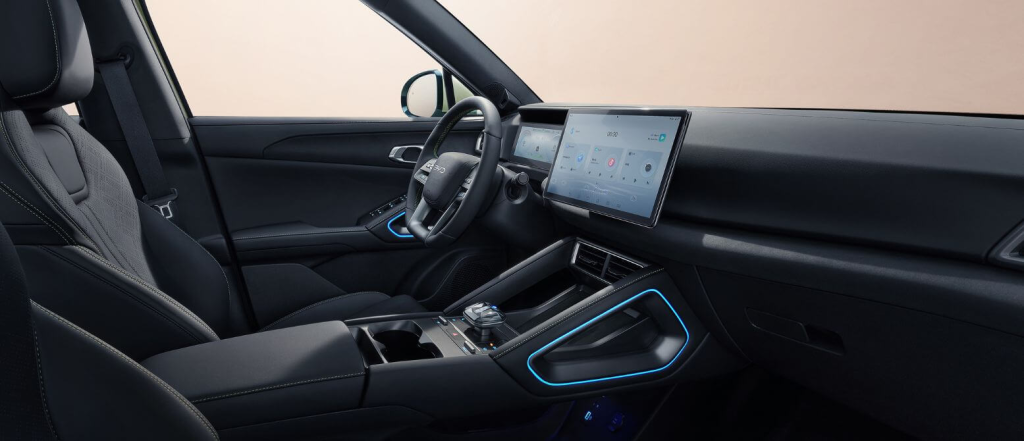
The BYD Atto 2 takes a modern approach to its interior, combining a clean dashboard layout with a mix of physical controls and touchscreen-based functions. The cabin is designed around everyday usability rather than an overly complicated layout.
The front seats offer a comfortable driving position, while the elevated SUV seating helps provide good visibility in Kathmandu traffic. The cabin also benefits from a relatively compact exterior, making the Atto 2 feel manageable without sacrificing too much interior space.
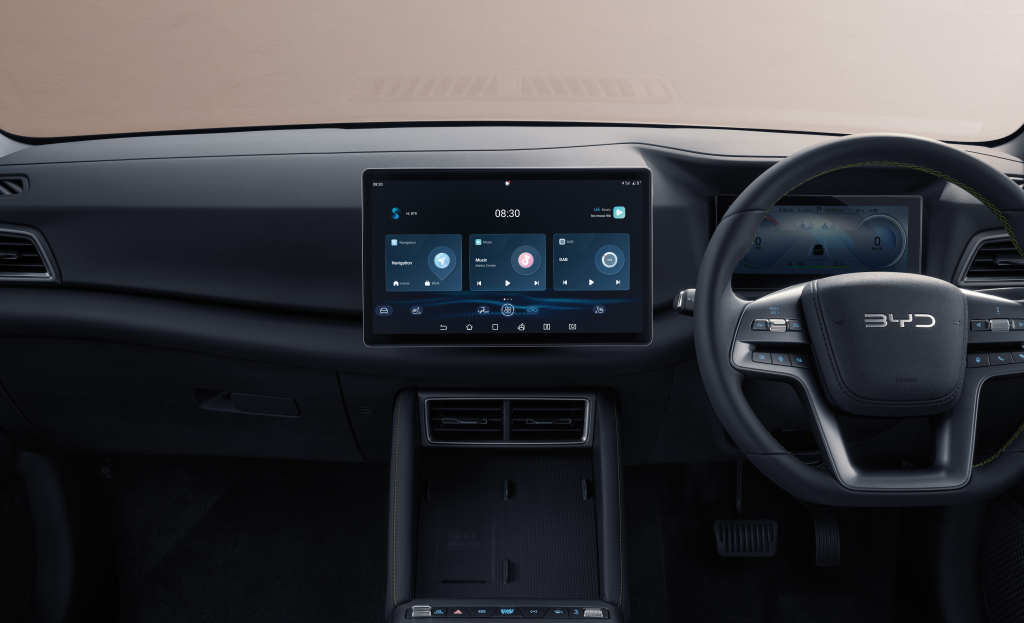
Technology is a major part of the cabin experience. Depending on the variant, features include a rotatable touchscreen infotainment system, digital instrument display, wireless smartphone connectivity, USB ports and a wireless charging pad.
For Nepal, the practical side of the interior is just as important. The Atto 2’s five-seat layout makes it suitable for small families, while the SUV-style cabin provides a useful balance between passenger space and compact dimensions.
Overall: The Atto 2’s interior is best suited to buyers who want a modern, technology-focused cabin with enough space for everyday family use without moving up to a larger SUV.
Rear-Seat Space and Family Comfort
The BYD Atto 2 offers five seats, making it suitable for small families and everyday passenger use. Its 2,620 mm wheelbase provides a reasonable amount of cabin space for a compact SUV.
The rear seats should be comfortable for typical daily journeys, although the Atto 2’s compact dimensions mean it is not designed to offer the same rear-seat space as a larger SUV.
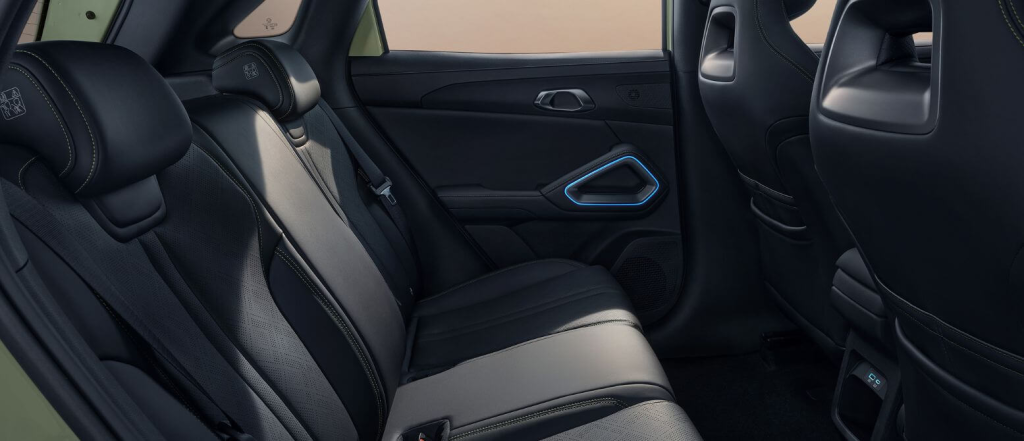
For families in Nepal, the flat-floor advantage of an EV can also make the rear cabin easier to use, particularly when carrying three passengers for shorter journeys. For longer trips, two adults in the rear should have a more comfortable experience than three.
Family suitability: The Atto 2 works well as a compact family EV for urban use, especially for buyers who prioritise manageable dimensions and everyday practicality over maximum rear-seat space.
Boot Space and Everyday Practicality
The BYD Atto 2 offers a 450-litre boot, which is a useful amount of space for a compact SUV. It should be sufficient for everyday shopping, luggage and the needs of a small family.
For longer trips around Nepal, the boot can accommodate regular travel luggage, although a family travelling with several large bags may need to use the rear-seat space as well.
The compact dimensions of the Atto 2 also make it easier to balance passenger and cargo requirements without becoming difficult to manoeuvre in Kathmandu.
Practicality: The 450-litre boot gives the Atto 2 a good balance between daily usability and family travel, making it practical for both city errands and weekend trips.
Technology and Safety Features
The BYD Atto 2 combines a modern infotainment system with a strong set of driver-assistance and safety features. Depending on the variant, equipment includes a rotatable touchscreen, digital instrument display, wireless smartphone connectivity, USB ports and wireless charging.
Safety equipment includes multiple airbags, electronic stability control, traction control, hill-hold assistance, a reversing camera and parking sensors. Higher-spec versions also offer additional driver-assistance features such as adaptive cruise control, lane-keeping assistance and blind-spot monitoring.
The Atto 2 also benefits from BYD’s Blade Battery and Cell-to-Body construction, which are important parts of its safety and structural design.
One important point for Nepali buyers is that the Atto 2 does not currently have a published Euro NCAP or ANCAP crash-test rating in the provided information. It would therefore be misleading to assign it a five-star safety rating based solely on its equipment list.
Overall: The Atto 2 offers a comprehensive safety and technology package, although buyers should distinguish between its available safety equipment and an independently verified crash-test rating.
Ride Quality and Ground Clearance
The BYD Atto 2 is designed primarily for urban and paved-road use, but its SUV proportions and approximately 200 mm of ground clearance give it some useful advantages on Nepal’s uneven roads.
Its suspension should handle common potholes, speed breakers and patched sections reasonably well when driven at appropriate speeds. The higher seating position also gives the driver a better view of the road ahead.
However, ground clearance alone does not make the Atto 2 an off-road vehicle. Nepal’s rough mountain tracks, deep potholes and rocky surfaces can still challenge a compact crossover. Extra caution is also needed when the vehicle is fully loaded with passengers and luggage.
For Nepal: The Atto 2’s ground clearance is a useful advantage for Kathmandu’s speed breakers and uneven roads, as well as regular hill highways. It is best suited to maintained roads rather than demanding off-road routes.
Owning a BYD Atto 2 in Nepal
For most buyers, the ownership experience of the BYD Atto 2 will depend on more than its purchase price. Service support, spare-parts availability, warranty coverage and charging access are especially important when owning an EV in Nepal.
BYD has an established presence in Nepal through its authorised distributor, giving Atto 2 owners access to dedicated service support. However, buyers outside Kathmandu should consider the availability of authorised service facilities along their regular travel routes.
The Atto 2’s Blade Battery technology and EV powertrain should also mean fewer routine mechanical maintenance requirements than a conventional petrol or diesel SUV.
For long-term ownership, battery warranty and replacement-part availability are worth checking before purchase. This becomes even more important for buyers who regularly travel to areas where EV service infrastructure is less developed.
Ownership verdict: The Atto 2 looks practical for everyday EV ownership in Nepal, particularly for buyers with home charging and access to established BYD service facilities. However, buyers outside major cities should confirm local service and parts support before purchasing.
BYD Atto 2 Ownership and After-Sales Support in Nepal
Service and Dealer Network
BYD Atto 2 owners in Nepal are supported through Cimex Inc., BYD’s authorised distributor. The established BYD network provides access to authorised service and maintenance support.
For buyers outside Kathmandu, it is worth checking the nearest authorised service centre before purchasing. This is particularly important if the car will be used regularly on longer hill and highway routes.
Spare Parts Availability
Spare-parts availability is an important consideration for any relatively new EV model. Routine maintenance items should be easier to source through the authorised network, while model-specific components may depend on local stock and import availability.
For buyers in Nepal, asking the dealer about expected availability and waiting times for major parts before purchase is a sensible step.
Warranty
The Atto 2’s warranty coverage is an important part of its ownership proposition. The provided information notes a vehicle warranty of 6 years or 150,000 km, while the battery warranty is listed at 8 years or 160,000 km.
However, promotional warranty packages and dealer offers can change. Buyers should confirm the exact warranty terms, exclusions and coverage applicable to their vehicle at the time of purchase.
Ownership takeaway: The Atto 2 benefits from BYD’s established presence in Nepal, but buyers outside major cities should consider service accessibility and spare-parts availability alongside the warranty when evaluating long-term ownership.
Running Cost of the BYD Atto 2 in Nepal
One of the biggest advantages of the BYD Atto 2 is its low day-to-day running cost compared with a petrol-powered SUV. With home charging, the main expense is electricity, while the electric powertrain also requires fewer routine mechanical maintenance items.
Based on the provided electricity-rate estimates, charging the 45.12 kWh Essential can cost roughly NPR 500–600, while the 51.13 kWh Premium may cost around NPR 560–680 for a full charge, including estimated charging losses.
This translates to an estimated NPR 1.8–2.5 per kilometre, depending on the variant, electricity tariff and driving conditions. Kathmandu traffic, frequent acceleration, air-conditioning and hilly roads can increase consumption.
For owners who can charge at home, the Atto 2 therefore offers a strong advantage for regular commuting. Frequent DC fast charging, however, can increase the overall cost, so home charging remains the more economical option for everyday use.
Resale Value of the BYD Atto 2 in Nepal
The BYD Atto 2 is still a relatively new model in Nepal, so there is not enough long-term resale data to confidently predict its future resale value.
However, BYD’s established presence in Nepal and the growing demand for EVs could support its resale prospects. Factors such as battery health, remaining warranty, service history, vehicle condition and overall EV market demand will likely have the biggest impact on its value.
The Premium variant’s larger battery and higher equipment level may also make it attractive in the used market, although this will depend on how the EV market develops.
For buyers planning to keep the Atto 2 for several years, resale value should therefore be considered as an uncertain factor rather than a guaranteed advantage.
Our take: The Atto 2 has reasonable potential for resale, but it is too early to make a strong prediction. Buyers should focus more on battery warranty, service history and overall ownership condition when considering its long-term value.
BYD Atto 2 Pros and Cons
After looking at the Atto 2’s price, range, performance and ownership experience, here are the key points to consider before buying it in Nepal.
Pros
- Competitive pricing — Starting at NPR 45.99 lakh, the Atto 2 sits in an attractive price range for a compact electric SUV.
- Low running cost — Home charging can keep everyday running costs relatively low.
- Good urban usability — Its compact dimensions and instant electric torque suit Kathmandu traffic.
- Useful ground clearance — The SUV stance is helpful on speed breakers and uneven roads.
- Modern technology — The touchscreen, connectivity features and available driver-assistance systems add to its appeal.
- Strong battery technology — BYD’s Blade Battery and e-Platform 3.0 are key highlights.
Cons
- Real-world range drops on hills — Steep climbs, heavy loads and air-conditioning can significantly reduce range.
- Front-wheel drive only — It is less suitable for muddy, slippery or demanding mountain roads.
- Charging infrastructure remains a consideration — Long-distance travel requires more planning outside established charging routes.
- Limited crash-test data — The provided information does not list a published Euro NCAP or ANCAP rating for the Atto 2.
- Resale value is still uncertain — The model has not been on the Nepalese used-EV market long enough to establish a clear resale trend.
BYD Atto 2 Alternatives in Nepal: Who Should Buy It?
The BYD Atto 2 sits in an increasingly competitive part of Nepal’s EV market. Its compact SUV dimensions, low running cost and practical range make it attractive, but the right choice depends on how and where you plan to drive.
BYD Atto 2 vs Alternatives
The closest alternatives include the BYD Dolphin, BYD Atto 3, Tata Nexon EV, MG ZS EV and Hyundai Kona Electric. The Atto 2 offers a middle ground between smaller urban EVs and larger electric SUVs.
If you want a smaller and more city-focused EV, the BYD Dolphin can make more sense. Buyers wanting a larger SUV with more space and capability may prefer the Atto 3 or other larger alternatives.
The Atto 2 is most appealing to buyers who want a compact SUV with a modern interior, useful ground clearance and manageable dimensions for Kathmandu without moving into a larger and more expensive EV.
Who Should Buy the BYD Atto 2?
The Atto 2 is a good fit for:
- Kathmandu-based daily commuters
- Small families wanting a compact SUV
- Buyers moving from a hatchback to an EV
- Drivers who can charge at home
- Buyers who mostly use paved roads and highways
- Those looking for lower running costs without choosing a very small EV
Who Should Consider Alternatives?
You may want to consider another EV if you regularly travel on rough mountain roads, muddy tracks or remote routes where front-wheel drive and limited charging infrastructure could become concerns.
Similarly, buyers who prioritise maximum range, larger cabin space or stronger highway performance may find a larger EV more suitable.
Overall: The BYD Atto 2 makes the most sense for buyers seeking a compact, practical and relatively affordable electric SUV for Nepal’s urban and paved-road conditions.
BYD Atto 2 Verdict
The BYD Atto 2 is a well-rounded compact electric SUV for Nepal, particularly for buyers who spend most of their time in Kathmandu and on paved highways. Its compact size, instant torque, useful ground clearance, modern features and low running costs make it practical for everyday use.
The NPR 45.99 lakh starting price also makes the Atto 2 an interesting option for buyers looking to enter the compact electric SUV segment. The Premium variant’s larger battery and longer claimed range make it more suitable for buyers who frequently travel outside the Valley.
However, the Atto 2 has limitations. Its front-wheel-drive setup and reduced range on steep climbs make it less suitable for demanding mountain roads. Nepal’s developing charging infrastructure is another factor to consider before planning frequent long-distance journeys.
TecNech Verdict: 8/10
| Category | Rating |
|---|---|
| Price & Value | 8.5/10 |
| Range | 8/10 |
| Performance | 8/10 |
| Comfort & Practicality | 8/10 |
| Technology & Safety | 8.5/10 |
| Nepal Suitability | 8/10 |
| Running Cost | 9/10 |
| Overall | 8/10 |
Should you buy the BYD Atto 2? If you want a compact electric SUV primarily for Kathmandu driving, family use and regular highway trips, the Atto 2 is a strong option worth considering. If your lifestyle involves frequent travel on rough mountain roads or remote routes, a more capable alternative may be a better fit.
For most urban Nepali buyers, however, the Atto 2 offers a convincing combination of price, practicality, technology and affordable running costs.